Andrew Langevin
Co-Founder
Mushroom Coffee Myths Debunked: Separating Fact from Fiction
Mushroom coffee has gone from niche biohacker beverage to mainstream wellness product. With that growth comes confusion, misconceptions, and outright myths. Let's separate fact from fiction with evidence-based answers to the most common mushroom coffee misunderstandings.
Myth #1: "Mushroom Coffee Will Get Me High"
The Myth
Many people assume that "mushroom coffee" contains psychoactive or hallucinogenic mushrooms—the kind associated with psychedelic experiences.
The Truth
Completely different mushrooms. Functional mushrooms used in coffee (Lion's Mane, Chaga, Reishi, Cordyceps, Turkey Tail) have absolutely zero psychoactive properties.
The confusion: The word "mushroom" creates association with psilocybin mushrooms (magic mushrooms), but these are entirely separate species with completely different compounds.
The reality:
- Functional mushrooms are legal food products
- They've been consumed safely for thousands of years
- They don't affect consciousness or perception
- You can safely drive, work, and function normally after consuming them
Bottom line: Mushroom coffee won't make you high. You'll simply have a cup of coffee with some additional functional compounds.
Myth #2: "It Tastes Like Eating Mushrooms"
The Myth
People expect mushroom coffee to taste strongly of mushrooms—earthy, fungal, and unappetizing.
The Truth
Mushroom coffee tastes primarily like coffee. The mushroom extracts add subtle earthy undertones, but the coffee flavor dominates.
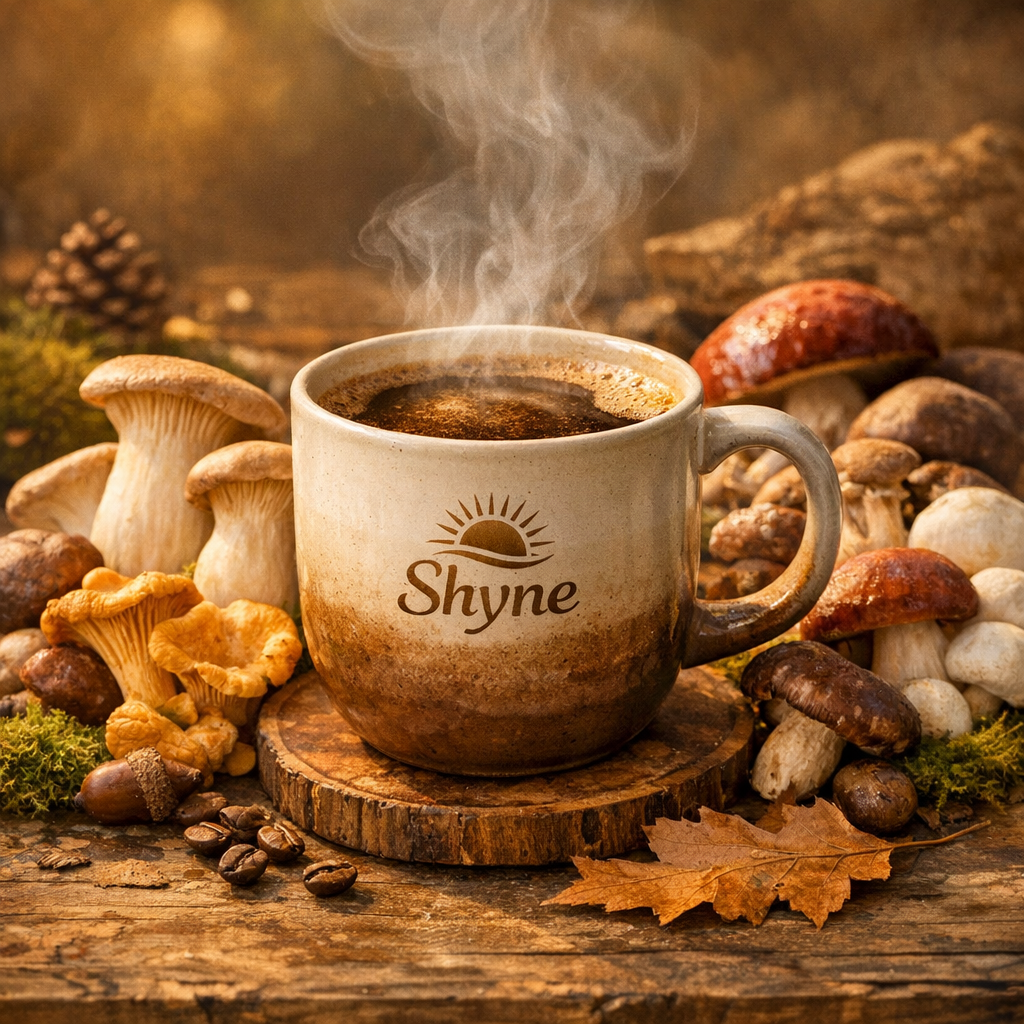
Why it doesn't taste "mushroomy":
- Extracts are concentrated and processed differently than whole mushrooms
- Amounts used are small (250-500mg)
- Coffee's strong flavor masks subtle mushroom notes
- Mushroom extracts don't have the same flavor profile as culinary mushrooms
What people actually report:
- "Slightly more complex than regular coffee"
- "A bit earthier"
- "I honestly can't tell the difference"
- "Coffee with depth"
If you hate mushrooms as food, you'll likely still enjoy mushroom coffee. The flavor profiles are completely different.
Myth #3: "It Has Way Less Caffeine"
The Myth
Some believe mushroom coffee is essentially decaf or has dramatically lower caffeine.
The Truth
Caffeine content varies by product, but many mushroom coffees contain similar caffeine to regular coffee.
Typical caffeine comparison:
- Regular coffee: 95-200mg per cup
- Mushroom coffee: 50-150mg per cup (varies widely)
- Decaf: 2-15mg per cup
Why this varies:
- Some brands use less coffee and more mushrooms (lower caffeine)
- Some brands use full-strength coffee with added mushrooms (similar caffeine)
- Some specifically market as lower-caffeine
- Always check the label
The energy difference people notice isn't necessarily from less caffeine—it's from how adaptogens may modulate the caffeine experience, making it feel smoother.
Myth #4: "The Mushrooms Don't Actually Do Anything"

The Myth
Skeptics believe functional mushrooms are just marketing hype with no real benefits.
The Truth
Functional mushrooms have thousands of years of traditional use AND growing modern scientific research supporting their benefits.
The evidence:
Lion's Mane:
- Multiple studies show NGF (Nerve Growth Factor) stimulation
- Human clinical trials demonstrate cognitive improvements in mild cognitive impairment
- Active compounds (hericenones, erinacines) are well-characterized
Reishi:
- Documented adaptogenic and calming properties
- Research on sleep quality and stress response
- Beta-glucans with demonstrated immune effects
Cordyceps:
- Studies showing improved oxygen utilization
- Research on ATP production and cellular energy
- Athletic performance studies (though more research needed)
Chaga:
- Among highest antioxidant content of any food (measured by ORAC)
- Beta-glucans with immune-modulating properties
- Anti-inflammatory compounds documented
Important context:
- Not all claims are equally supported
- More human research is still needed
- Benefits may be subtle and cumulative
- Quality of products matters significantly
Bottom line: The mushrooms have real, documented bioactive compounds. Whether you personally notice benefits depends on many factors, but "placebo only" isn't accurate.
Myth #5: "It's Just a Trend That Will Disappear"
The Myth
Mushroom coffee is a fad that will fade like other wellness trends.
The Truth
Functional mushrooms have been used for over 5,000 years across multiple cultures. Modern mushroom coffee is a new delivery method for an ancient practice.
Historical staying power:
- Chinese medicine has used functional mushrooms since 200 BCE
- Siberian cultures have consumed Chaga for centuries
- Japanese medicine incorporated shiitake and reishi for over 1,000 years
Modern momentum:
- Research publications on medicinal mushrooms have increased exponentially
- The functional mushroom market is growing 8-10% annually
- Mainstream acceptance is increasing
- Major food companies are entering the space
This isn't a trend—it's a traditional practice meeting modern convenience.
Myth #6: "You Need to Drink A Lot to See Benefits"
The Myth
Some believe you need multiple cups or high doses to experience any benefit.
The Truth
Research-backed doses are typically:
- Lion's Mane: 250-500mg per day
- Reishi: 250-500mg per day
- Chaga: 250-500mg per day
- Cordyceps: 250-500mg per day
Most quality mushroom coffees provide this in a single serving.
More isn't always better:
- Adaptogens work cumulatively over time
- Consistency matters more than quantity
- Higher doses don't necessarily mean better results
- Some compounds may have a ceiling effect
The key is daily consistency, not high single doses.
Myth #7: "All Mushroom Coffees Are the Same"
The Myth
One mushroom coffee is as good as another—they're all equivalent.
The Truth
Quality varies enormously between products.
Key differences:
Extract quality:
- Full spectrum extract (both fruiting body + mycelium): Complete profile of beneficial compounds
- Raw powder (unextracted): Cheaper, less potent, may contain filler
- Some products don't specify extraction method (red flag)
Extraction methods:
- Hot water extraction: Releases beta-glucans
- Dual extraction: Captures more compounds
- No extraction: Less bioavailable compounds
Amounts:
- Some products contain therapeutic doses (250-500mg)
- Some contain trace amounts (essentially window dressing)
- "Proprietary blend" can hide low amounts
Coffee quality:
- Organic vs. conventional
- Arabica vs. Robusta
- Roast quality varies
Not all products deliver on their promises. Research brands before buying.
Myth #8: "It's Not Safe to Drink Daily"
The Myth
Daily mushroom coffee consumption might be harmful or have unknown long-term effects.
The Truth
Functional mushrooms have been consumed daily in traditional medicine for thousands of years with excellent safety records.
Safety considerations:
Generally recognized as safe:
- No significant adverse effects in research
- Traditional use over millennia
- FDA doesn't restrict functional mushrooms as supplements
Who should be cautious:
- Pregnant or nursing women (limited research)
- People on blood thinners (some mushrooms affect clotting)
- Those with autoimmune conditions (immunomodulators may have effects)
- People with mushroom allergies (rare but possible)
The caffeine in mushroom coffee is the same caffeine in regular coffee, with the same considerations (limit to 400mg/day for most adults).
Bottom line: For most healthy adults, daily mushroom coffee is safe. The mushrooms have better safety profiles than many common supplements.
Myth #9: "It Works Immediately"
The Myth
You'll feel dramatic benefits from your first cup.
The Truth
Caffeine effects are immediate. You'll feel alert.
Mushroom benefits take time:
- Adaptogens work cumulatively
- NGF stimulation (Lion's Mane) takes weeks to show effects
- Immune benefits build over time
- Most people notice changes after 2-4 weeks of consistent use
What to expect:
- First cup: Coffee-like alertness, possibly smoother energy
- First week: Getting used to it, possibly noticing energy quality differences
- 2-4 weeks: Adaptogenic benefits may become noticeable
- Ongoing: Benefits may continue to compound
This isn't a limitation—it's how adaptogens work. Quick fixes don't build resilience; consistent practice does.
Myth #10: "It's Too Expensive"
The Myth
Mushroom coffee is overpriced luxury product not worth the premium.
The Truth
Price comparison needs context:
Mushroom coffee cost:
- $1-2 per serving for quality products
- Often comparable to specialty coffee shops
What you're getting:
- Coffee + mushroom supplements in one product
- Quality Lion's Mane capsules alone cost $0.50-1.50 per serving
- You're paying for convenience and combined benefits
Value calculation:
- If you'd buy coffee anyway AND benefit from mushrooms, the premium is minimal
- Compared to other supplements, it's often equivalent or cheaper
- Compared to coffee shop drinks, it's much cheaper
Subscriptions often reduce cost significantly (many brands offer 30-50% off).
The Bottom Line: What's Actually True
Mushroom coffee IS:
- A coffee with functional mushroom extracts
- Safe for most people with daily use
- Backed by traditional use and growing modern research
- A convenient way to consume adaptogens
- Similar in taste to regular coffee
Mushroom coffee IS NOT:
- Psychoactive or hallucinogenic
- A miracle cure for anything
- Immediately transformative
- All the same between brands
- Replacing necessary medical care
The truth is nuanced: Mushroom coffee isn't magic, but it's not fake either. It's a legitimate functional beverage with real compounds that may support wellness over time—delivered in a format most people already enjoy.
Related Reading: