Andrew Langevin
Co-Founder
How to Choose the Best Mushroom Coffee: A Buyer's Guide
Not all mushroom coffee is created equal. The market ranges from high-quality products with real benefits to glorified instant coffee with negligible mushroom content.
This guide teaches you how to evaluate mushroom coffee products so you can find one that actually delivers on its promises.
The 5 Key Factors
1. Full Spectrum vs. Single-Source Extracts
This is the most important quality indicator.
Full Spectrum Extract (Best)
- Uses both the fruiting body (the visible mushroom) and mycelium (the root network)
- Captures the complete range of beneficial compounds from the entire organism
- Fruiting body provides concentrated beta-glucans and triterpenes
- Mycelium contributes unique enzymes and metabolites not found in the fruiting body
- Dual extraction (water + alcohol) unlocks both water-soluble and alcohol-soluble compounds
Raw Mushroom Powder (Inferior)
- Simply ground-up mushroom material without proper extraction
- Your body can't break down chitin cell walls effectively
- Much of the beneficial compounds remain locked away
- Significantly less bioavailable
Why it matters:
A product using raw, unextracted mushroom powder—regardless of the source—delivers far fewer beneficial compounds than a properly dual-extracted full spectrum product. The extraction method matters more than whether a product uses fruiting body alone or includes mycelium.
What to look for:
- "Full spectrum extract" or "dual extracted" on the label
- Products that specify beta-glucan content (should be >20%)
- Brands that are transparent about their extraction process
2. Extraction Method
Mushrooms have tough cell walls (chitin) that must be broken down to release beneficial compounds.
Hot Water Extraction
- Traditional method
- Extracts beta-glucans and polysaccharides effectively
- Good for immune-supporting compounds
Dual Extraction (Best)
- Combines hot water + alcohol extraction
- Captures both water-soluble (beta-glucans) and fat-soluble (triterpenes) compounds
- Most comprehensive extraction
- Especially important for Reishi and Chaga
No Extraction (Poorest)
- Just ground-up mushroom or mycelium
- Compounds locked behind cell walls
- Significantly reduced bioavailability
- Often the cheapest products
What to look for:
- "Dual extracted" or "hot water and alcohol extracted"
- "1:1 extract" or similar extract ratios
- Avoid products that just list "mushroom powder" with no extraction mention
3. Dosage and Transparency
Effective dosages (based on research):
| Mushroom | Typical Research Dose | Minimum for Noticeable Effects |
|---|---|---|
| Lion's Mane | 500mg - 3g daily | 500mg |
| Reishi | 1.5g - 9g daily | 500mg extract |
| Chaga | 500mg - 3g daily | 500mg |
| Cordyceps | 1g - 3g daily | 500mg |
| Turkey Tail | 1g - 3g daily | 500mg |
Red flags:
- "Proprietary blend" with no individual amounts listed
- Extremely low doses (100mg total mushroom content)
- Unclear about what's included
What to look for:
- Individual mushroom amounts listed clearly
- Total mushroom content per serving
- At least 250-500mg of each primary mushroom
4. Third-Party Testing
Quality products are tested independently for:
Purity:
- Heavy metals (lead, mercury, cadmium, arsenic)
- Pesticides
- Microbial contamination
- Mold and mycotoxins
Potency:
- Beta-glucan content
- Actual mushroom content (vs. grain filler)
- Active compound verification
What to look for:
- "Third-party tested" on label or website
- Certificate of Analysis (COA) available upon request
- Specific test results published
- Testing by recognized labs
Red flag: Companies that can't or won't provide testing information
5. Coffee Quality
The coffee base matters too:
Consider:
- Organic vs. conventional
- Single origin vs. blend
- Arabica vs. Robusta
- Roast level and taste
- Caffeine content
For quality coffee:
- Arabica beans (smoother, less bitter)
- Organic (reduces pesticide exposure)
- Medium roast (balances flavor with mushroom notes)
- Clearly stated caffeine content
Red Flags to Avoid
1. Unrealistic Claims
Avoid products that claim to:
- Cure diseases
- Cause rapid weight loss
- Replace medications
- Provide "instant" dramatic results
Legitimate mushroom coffee offers support and benefits, not miracles.
2. Hidden Ingredients
Watch for:
- Artificial sweeteners
- "Natural flavors" (vague and potentially problematic)
- Excessive sugar
- Unnecessary additives
- Fillers like maltodextrin
3. Suspiciously Low Prices
Quality mushroom extracts are expensive to produce. If a product is dramatically cheaper than competitors, question:
- Are they using raw powder instead of proper extracts?
- Is the mushroom content negligible?
- Are extractions being skipped?
- Is quality control adequate?
4. No Mushroom-Specific Information
Avoid products that:
- Don't specify which mushrooms are included
- Don't list amounts of each mushroom
- Can't provide information about sourcing
- Have no extraction method mentioned
5. Fake Reviews
Be skeptical of:
- Only 5-star reviews
- Generic, vague praise
- Reviews that read like advertisements
- No critical or balanced reviews
Reading Labels: A Practical Guide
Example of a Good Label
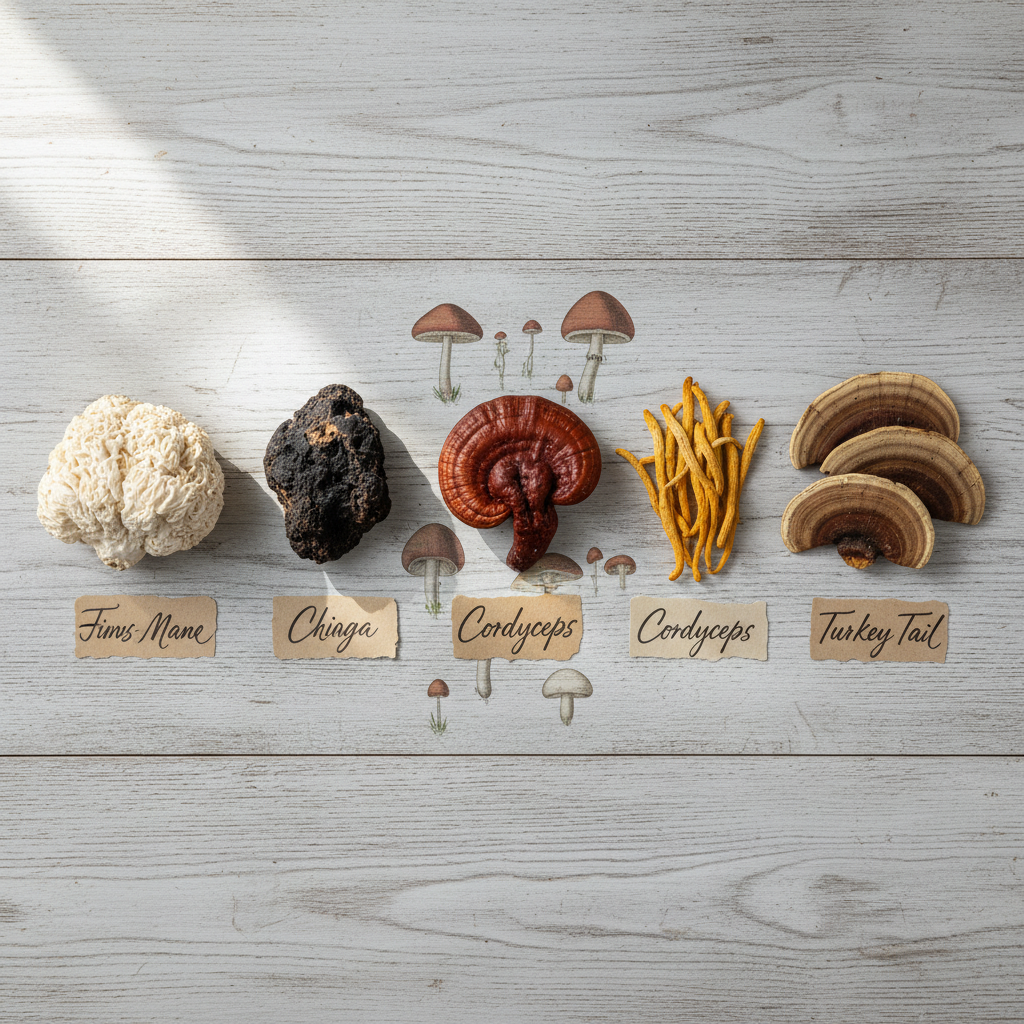
Ingredients: Organic Arabica Coffee, Lion's Mane Extract (Hericium erinaceus, full spectrum, dual-extracted, 500mg), Chaga Extract (Inonotus obliquus, full spectrum, dual-extracted, 250mg), Cordyceps Extract (Cordyceps militaris, 250mg)
What's good here:
- Specifies full spectrum extract source
- Lists extraction method (dual extraction)
- Provides individual amounts
- Uses quality coffee
Example of a Poor Label
Ingredients: Coffee, Mushroom Blend (Proprietary formula containing lion's mane, reishi, chaga, cordyceps, turkey tail, shiitake - 300mg)
What's wrong:
- "Proprietary blend" hides individual amounts
- 300mg total for 6 mushrooms is ~50mg each (far too low)
- No mention of extract source or spectrum
- No extraction method specified
Questions to Ask Before Buying
- Full spectrum or single-source extract? (Want: full spectrum dual extraction)
- What's the extraction method? (Want: dual or hot water extraction)
- How much of each mushroom per serving? (Want: 250-500mg minimum each)
- Is it third-party tested? (Want: yes, with COA available)
- What's the caffeine content? (Want: clearly stated)
- Where are the mushrooms sourced? (Want: transparent sourcing)
- Can they provide lab results? (Want: readily available)
Where to Buy
Direct from Brands
Pros:
- Freshest product
- Full information available
- Subscription options
- Customer service access
Cons:
- Shipping costs
- Limited ability to compare
Amazon
Pros:
- Easy comparison shopping
- Reviews available
- Fast shipping
Cons:
- Counterfeit risk (buy only from brand's official store)
- Some reviews may be fake
- Quality varies widely
Health Food Stores
Pros:
- Staff may be knowledgeable
- Can examine product before buying
- No counterfeits
Cons:
- Limited selection
- Usually higher prices
- May not carry best brands
Recommendation
Buy directly from reputable brands when possible, especially for your first purchase. Once you find a product you like, you can often find it on Amazon from the brand's official store at competitive prices.
Top Qualities in Reputable Brands
Look for companies that:
- Specialize in mushrooms (not just another product in their line)
- Provide extensive education on their website
- Offer transparency about sourcing and testing
- Have knowledgeable customer service
- Stand behind their products with guarantees
- Have been in business for several years
- Are referenced by health professionals
Frequently Asked Questions
How much should quality mushroom coffee cost?
Expect $1-2 per serving for quality products. Less than $0.50 per serving likely indicates compromises. More than $3 per serving may be overpriced unless it's a premium specialty product.
Instant vs. ground—which is better?
Instant is more convenient; ground may offer fresher flavor. Quality matters more than format. Many top products are instant for easier mushroom integration.
Should I buy single-mushroom or multi-mushroom products?
Multi-mushroom blends offer diverse benefits. Single-mushroom products allow targeted use for specific goals (like focus or energy). Both can be high-quality.
How can I verify a brand's claims?
Ask for their Certificate of Analysis (COA). Reputable brands provide this readily. If they can't or won't, consider other options.
Does organic matter for mushroom coffee?
Organic certification for both coffee and mushrooms reduces pesticide exposure. It's a plus but not the most critical factor—extraction method and extract quality matter more.
The Bottom Line
Quality mushroom coffee should:
- Use full spectrum dual-extracted mushroom extracts (both fruiting body and mycelium)
- Be properly extracted (dual extraction ideal)
- Contain effective doses (250-500mg+ per mushroom)
- Be third-party tested for purity and potency
- Use quality coffee as the base
- Be transparent about all ingredients and amounts
Take time to evaluate products before buying. The difference between high-quality and low-quality mushroom coffee is the difference between real benefits and expensive placebo.
Related Reading: